
How an Art Museum Became a Catalyst for Community
Ten years ago, a shuttered bank in Harrisburg reopened as the Susquehanna Art Museum—an ambitious act of reinvention that would quietly ignite a decade of cultural renewal in the Midtown neighborhood. The move marked a turning point, not just for the institution but for the community it aimed to serve.
EwingCole led the architecture and engineering design of the 20,000 SF museum, aiming to capitalize on the history of the bank building while providing a modern, flexible museum environment that fosters appreciation of the arts and arts education for Harrisburg residents and visitors across south central Pennsylvania.

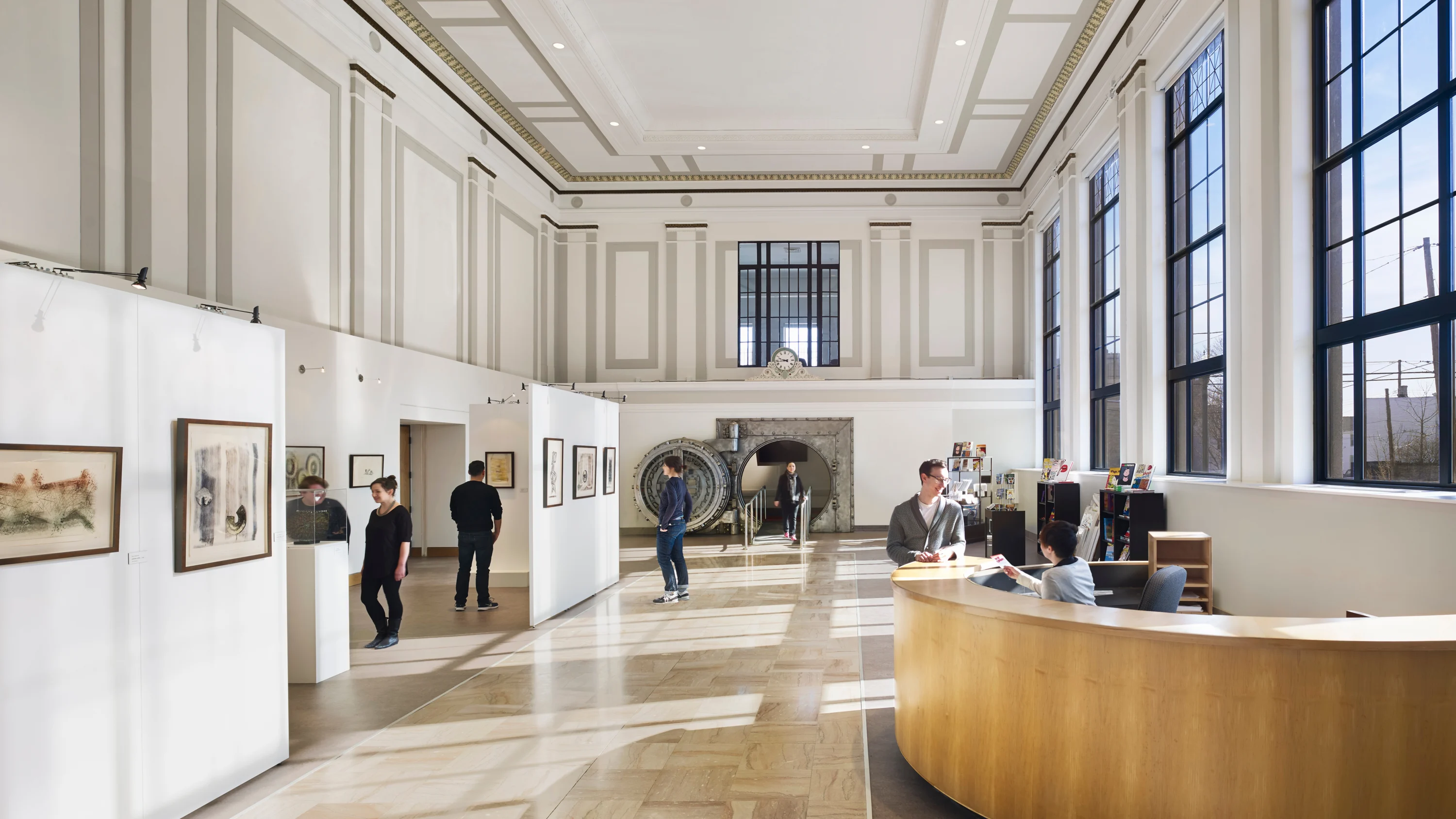
The project featured an entrance gallery with fully restored 27-foot gold-leaf ceilings, and the bank’s original vault door remains an eye-catching element of the gallery, serving as a nod to the building’s past. The expansion includes classrooms on the ground floor and creates an environmentally controlled main gallery that hosts exhibitions and doubles as the museum’s event space. Today, the museum is thriving in ways its founders could hardly have imagined when it made the space its permanent home, thanks in no small part to a design rooted in flexibility, purpose, and potential.
“We had to adapt on the fly. There was no playbook. But we had a building that could respond to us just as much as we could respond to it.”
– Susquehanna Art Museum Executive Director, Alice Anne Schwab

Designing for Flexibility and the Unknown
From the outset, the design team approached the project with adaptability in mind. The renovation preserved the iconic neoclassical façade of the former Keystone Bank while reconfiguring the interior into a contemporary series of galleries and program spaces, adding essential flexibility to the project. The project’s scope includes two main galleries—the second-floor Lehr Gallery and the flexible display area within the bank’s open lobby, the Doshi Gallery.
The mindset of EwingCole’s Cultural team going into the project was to create a cultural environment that reflected its community, was forward-looking, and sustainable.
As the museum prospered, visitor and student engagement increased. Today, the museum boasts five exhibition spaces, including the DeSoto Family Vault and the Patricia L. Murray Gallery, all of which were carved out of previously underutilized areas. For example, what was once a corridor to restrooms and staff storage now serves as the Pollock Foundation Education Center Gallery, a dedicated venue for student and emerging artist work. This incremental evolution wasn’t accidental. It was made possible by a design that left room for growth, literally and figuratively.
“We didn’t know what the museum would need to be. But the design left us with choices. We could respond to new ideas and new opportunities as they came up.”
– Alice Anne Schwab

Susquehanna Art Museum Executive Director, Alice Anne Schwab.
A Catalyst for Community Development
While the building adapted internally, its presence began to reshape the neighborhood externally. Schwab recalls an early conversation with a developer behind the nearby Millworks restaurant and artist studios. “He told me he wouldn’t have taken the risk if the museum hadn’t planned to open on the nearby site.”
Momentum continued. What was once a disinvested corridor is now the newly designated Harrisburg Arts District. Small businesses, bars, fitness studios, and artist-run boutiques have opened near the museum, many citing its presence as a driver of foot traffic and visibility.

With thoughtful programming and outreach, the museum has become an integral part of the daily rhythms of Midtown.
Local partnerships, from art collectives to charter schools, now shape both the exhibitions and educational programs on offer. One of the most impactful relationships is with the nearby Harrisburg STEAM Academy, a public charter school that brings students into the museum every week.
“They come in ready to engage with what they see. They’re not just learning about art. They’re learning how to navigate a cultural space. It’s part of building lifelong museum-goers.”
– Alice Anne Schwab

Making Room for More Voices
As the neighborhood changes, so too does the museum’s understanding of its audience. Schwab and her team are grappling with questions central to every cultural institution today: Who is our community? Who do we serve? Who might we still be missing?
Through exhibitions like Patricia Montgomery’s swing coats—textile pieces that commemorate unsung heroines of the Civil Rights movement—the museum has found ways to connect local audiences to broader cultural narratives. The show not only brought new voices into the museum but also fostered collaborations with organizations such as the African American Quilters Association and Shippensburg University’s fashion archives.
“This is how we build community. One relationship, one story at a time.”
– Alice Anne Schwab

To Be Continued
The next chapter of the Susquehanna Art Museum’s evolution will expand physically, albeit modestly. A new courtyard, located just north of the building, is under construction and designed to host outdoor educational programs, small events, and installations. But Schwab is quick to note that future growth isn’t just about real estate; it’s about relevance.
“The building can’t do everything for us. We need to keep asking ourselves: Are we creating space for the people we want to serve? Are we building something they want to be part of?”
– Alice Anne Schwab

In other words, the same principles that shaped the original realization of the museum (openness, flexibility, responsiveness) are the very qualities now guiding the institution itself. And after a decade of transformation, the Susquehanna Art Museum is ready to do it again.