
Designing With Nature, Not Against It
Insights
Along the tidal marshes of South Carolina’s Lowcountry, land and water meet in quiet transitions. Marsh grasses move with the tide. Live oaks stretch their canopies over roads, marshes, and fields. Creeks and inlets weave through the landscape before reaching the Atlantic. Within this delicate system of wetlands, forests, and waterways exists Kiawah Island.
Designing within such an environment requires restraint and demands alignment with the forces that define it. For EwingCole’s Sports & Entertainment team, this context became the foundation for a design exploration: how to deliver a high-performance, net-zero civic building within one of the country’s most fragile coastal ecosystems.
The project illustrates a design approach rooted in environmental stewardship, energy performance, and community engagement, offering a framework for the coexistence of energy-intensive cultural facilities with fragile coastal ecosystems.
A Landscape That Shapes Design
Kiawah Island’s identity is inseparable from its landscape. The conceptual site, once an indigo farm, is framed by wetlands, tidal waterways, and mature live oaks. Instead of reshaping the terrain, the design is molded by it.
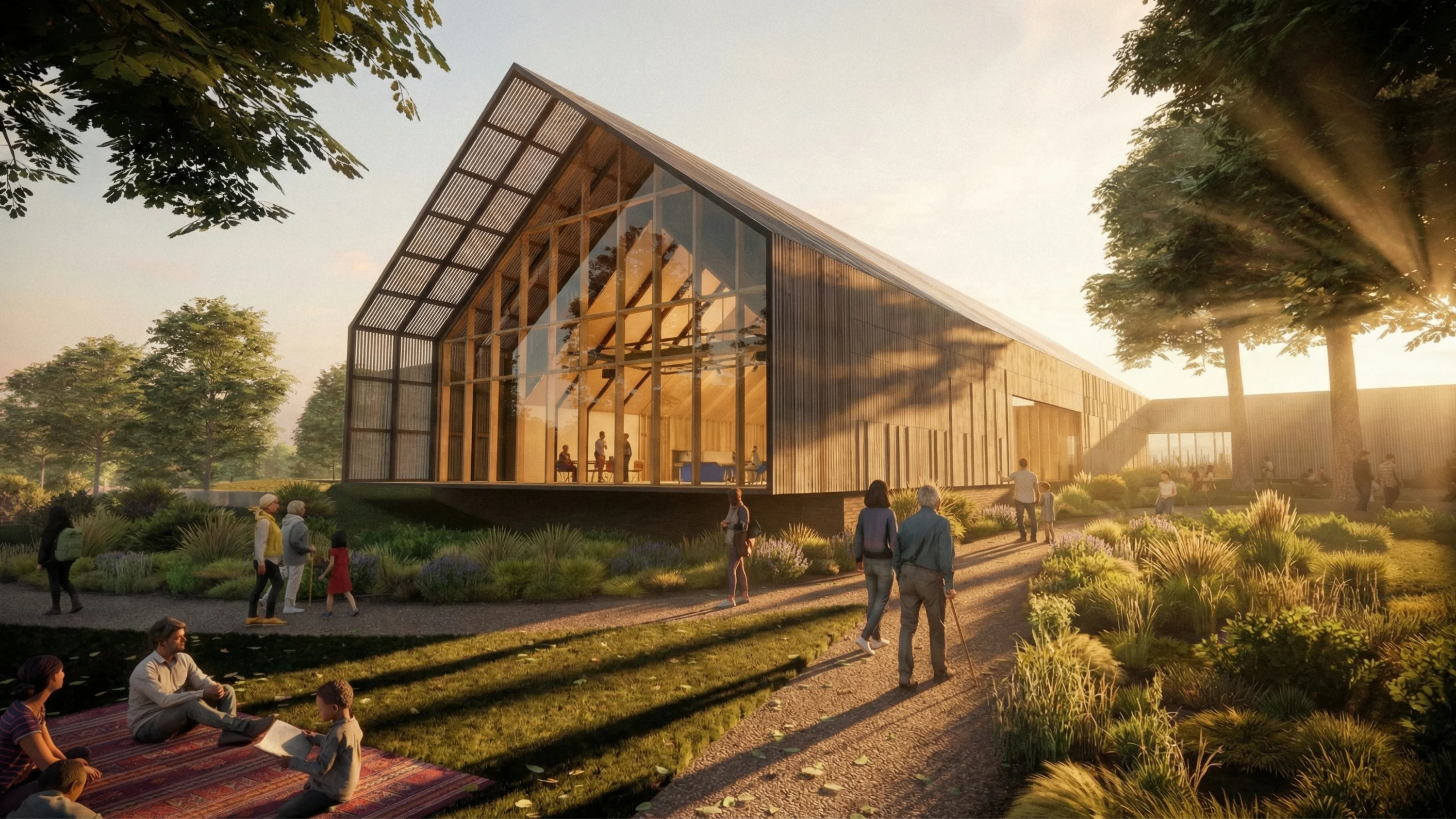
The building is carefully positioned within existing natural constraints, fitting into the site like a precise intervention rather than a transformation. Arrival unfolds as a choreographed sequence through shaded paths leading to a welcoming front porch that reflects the Lowcountry vernacular, while interior spaces gradually open onto expansive marsh views.

Arrival unfolds as a choreographed sequence through shaded paths leading to a welcoming front porch that reflects the Lowcountry vernacular.
This sense of procession is intentional. Architecture becomes a lens through which the landscape is revealed, not obscured.
The building’s form is equally purposeful. A simple, elongated roof oriented south-southwest maximizes solar exposure, supporting a photovoltaic array sized to meet operational demand. At the same time, the geometry responds directly to programmatic needs, with larger volumes, such as the theater, shaping the roof profile and enabling energy production.
Material and massing strategies further reinforce performance. Opaque support spaces, such as storage and dressing rooms, buffer solar exposure along the most sun-exposed façades, while glazing in concentrated where daylight and views provide the greatest value. The result is a building that operates as a passive system, reducing reliance on mechanical infrastructure.

The building is carefully positioned within existing natural constraints, fitting into the site like a precise intervention rather than a transformation.
Net-Zero Energy and the Architecture of Performance
Cultural buildings are inherently energy-intensive. Performance venues require sophisticated lighting, acoustics, and mechanical systems, all of which increase demand.
This study flips the equation. Rather than relying on offsets, the design prioritizes reduction first, then production.
South Carolina benefits from abundant year-round sunlight, and the building takes advantage of this through its positioning. Orientation, envelope performance, and spatial organization work together to lower energy loads. A south-facing roof plane supports a photovoltaic system calibrated to match demand, while mechanical strategies emphasize efficiency and simplicity. The team reduced duct runs and equipment volumes wherever possible, lowering energy demand while minimizing acoustic disruption in performance spaces.
Material selection plays a critical role. The use of Accoya wood, a modified, sustainably sourced timber, provides durability in harsh coastal conditions without the need for chemical treatments. Its resistance to moisture, insects, and salt air ensures long-term performance, while its adaptability allows it to function as cladding, screening, and shading.
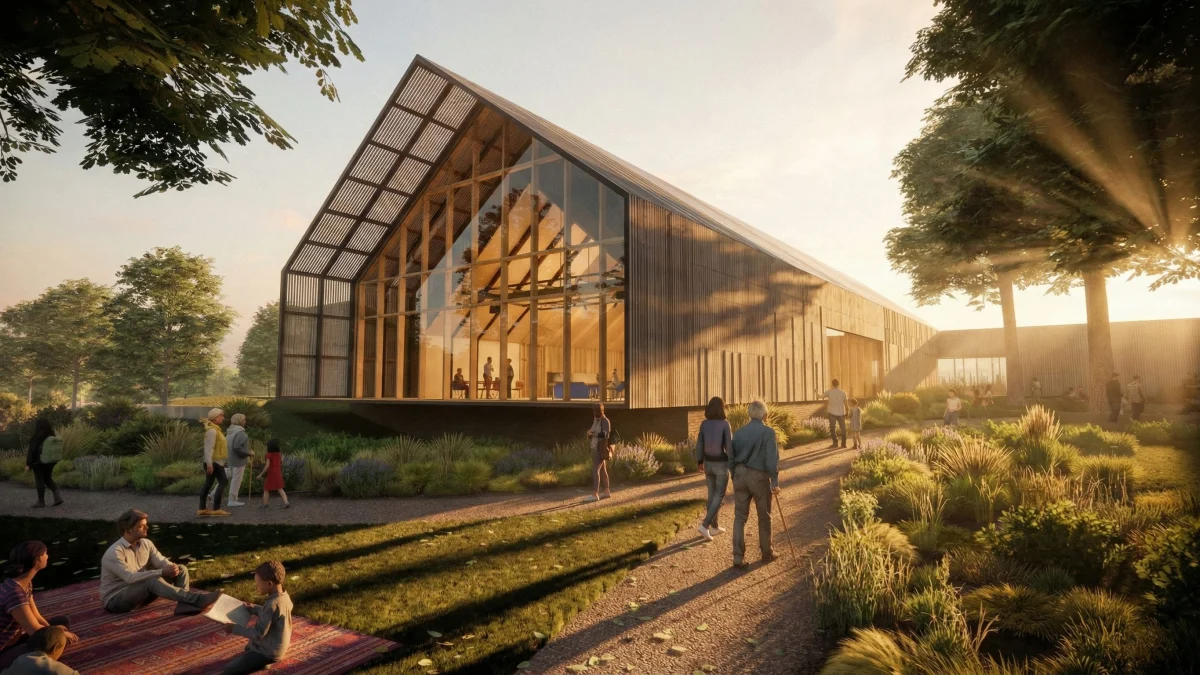
South Carolina benefits from abundant year-round sunlight, and the building takes advantage of this through its positioning, while material selection ensures long-term, optimal performance.
Restoring Ecology Through Design
Beyond the building, the overall design doubles as an ecological restoration project, reestablishing the site as a natural and public resource.
The design team, consisting of architects, engineers, landscape designers, and environmental scientists, evaluated existing conditions and developed a strategy to restore native plant species, stabilize marsh edges, and reestablish wildlife habitats. This approach positions the landscape as infrastructure that supports biodiversity and, by extension, the performing arts center, while strengthening resilience to storm surge, coastal flooding, and erosion.
The site also becomes an educational resource. Trails with interpretive exhibits and outdoor classrooms introduce visitors to the Lowcountry’s ecology and cultural history, including its legacy of indigo farming. In this way, the landscape performs multiple roles, including ecological, educational, and civic.

Beyond the building, the overall design doubles as an ecological restoration project, reestablishing the site as a natural and public resource.
A Civic Gateway for Community Life
At its core, the project remains a civic, performing arts building.
A 300-seat venue anchors the program, designed to host music, lectures, and community events. A large feature window, serving as the backdrop to performances, frames views of a historic oak tree and the marsh beyond, blurring the boundary between performance and place.
Outdoor spaces extend the experience. Lawns accommodate concerts under the canopy of live oaks, while trails and waterfront access invite year-round recreational use. Accessibility is fundamental. The park remains open to the public regardless of the building operations, reinforcing its role as a shared public space.

A large feature window, serving as the backdrop to performances, frames views of a historic oak tree and the marsh.
Lessons From a Design Exploration
As a conceptual study, the project reflects a broader approach to design.
It demonstrates how environmental responsibility, cultural programming, and community identity can converge into a single, cohesive strategy. It also underscores the value of interdisciplinary collaboration, bringing together architects, engineers, landscape designers, and environmental specialists to shape a more holistic outcome.
The takeaway is clear. In environmentally sensitive contexts, architecture has the opportunity to do more than minimize impact. It can actively strengthen the systems around it.
For EwingCole, this work reinforces a guiding principle that the most meaningful design solutions begin with a deep understanding of place. When architecture grows from the landscape, it has the power to enrich both the built and natural environment and community.

Additional contributors to this article include: Matthew Barnett, AIA, Jason Kolano, AIA, and Evan McIver.