
Press
Knight Architecture updates Louis Kahn’s Yale Center for British Art with new skylights and light-diffusing cassettes
New Haven, Connecticut—and Yale University, more specifically—possesses two of only three Louis Kahn–designed museums. (The other is the Kimbell, in Fort Worth, Texas.) The architect’s extension to the Yale Art Gallery (1953) and the posthumously completed Yale Center for British Art (1974) straddle either side of Chapel Street, bookending the prolific period of his career; the former was Kahn’s first major commission, and the latter is among his final works. Despite the nearly 20 years between them, the projects are set in undeniable dialogue, beginning with their modest rectangular massing, which may come as a surprise to those familiar with Kahn’s more formally expressive designs.
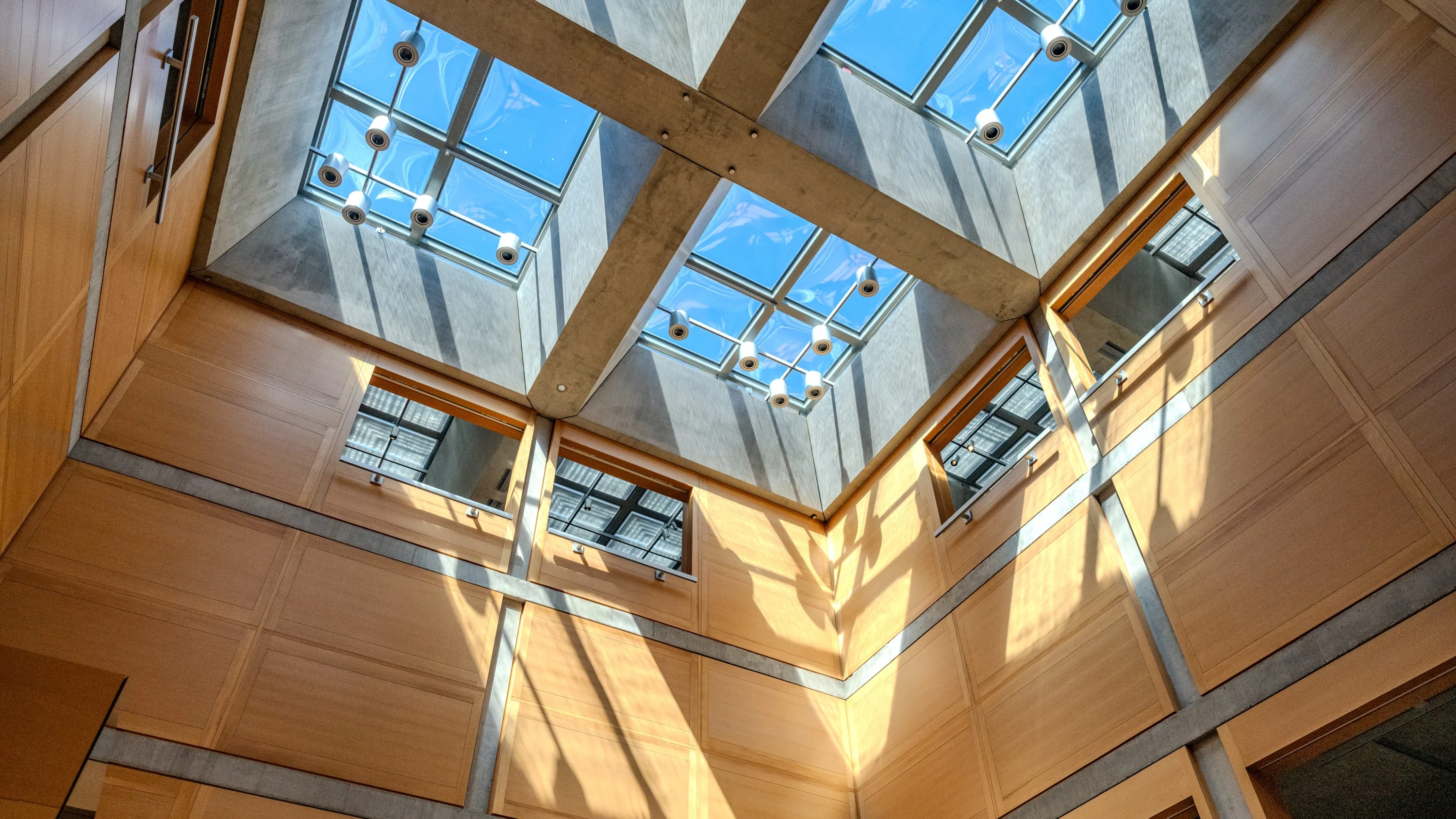
For the past two years, a major renovation at the Yale Center for British Art (YCBA) severed this architectural pairing. The project focused on repairing what is arguably the building’s premier architectural feature: a grid of 224 skylights that bring natural light into the exhibition space.
YCBA’s structural organization follows from this grid. Kahn arranged the museum’s galleries within a network of repeating 20-by-20- foot cast-in-place concrete bays that each align beneath four rooftop apertures. This rigid compositional pattern continues down through the building’s four floors and is only interrupted twice: by multistory chasms that occur in the lobby and again in the center of the building to create an indoor “courtyard” and event space. A cylindrical concrete stairwell punctuates the event space; an earlier version of this drum-shaped design exists in the Yale Art Gallery across the street.