
Jocco’s Ransom: How History’s Tall Tales Inspire Design
Insights
Irving Plaza, a famous punk-rock music venue between Midtown and Lower Manhattan, closed in 2019 for renovation and remained shuttered as the COVID-19 pandemic raged on. Its doors finally opened in 2021 to a brand-new venue that elevates the concertgoing experience while preserving the building’s historic charm.
Early in the design process, EwingCole’s design team was presented with a wealth of old newspaper clippings and public records that narrated the building’s history across generations. From its origins as private dwellings in the 1870s to its transformation into an upscale hotel and later a public meeting hall and concert venue, these documents served as the foundation for the renovation design, bridging the gap between the past and the present.
“It was just supposed to be a refresh, but as we dug more into it, we could see deep into the building’s history,” said Interior Designer Shannon Noon, IIDA.

An advertisement for the Hotel del Rocreo, the former occupant of 15 & 17 Irving Place before it became the Hotel America.
Each interior design element celebrates a moment in the building’s storied past and the individuals who once walked its halls. By 1800, 15 Irving Place was a hotel called Hotel America (later known as the Hotel de Recreo), a favorite for upper-class Spanish-speaking foreign travelers. Two articles from the New York Times and the Philadelphia Inquirer tell the story of one of Hotel America’s VIP guests, Mrs. Rosalía Abreu, and her favorite pet monkey, Jocco. Abreu, a Cuban aristocrat and primate lover, famously trained and collected roughly 200 primates in her home, which she kept as pets.

Rosalía Abreu was known for being one of the first to breed a chimpanzee in captivity and is credited with pioneering the study of primates.
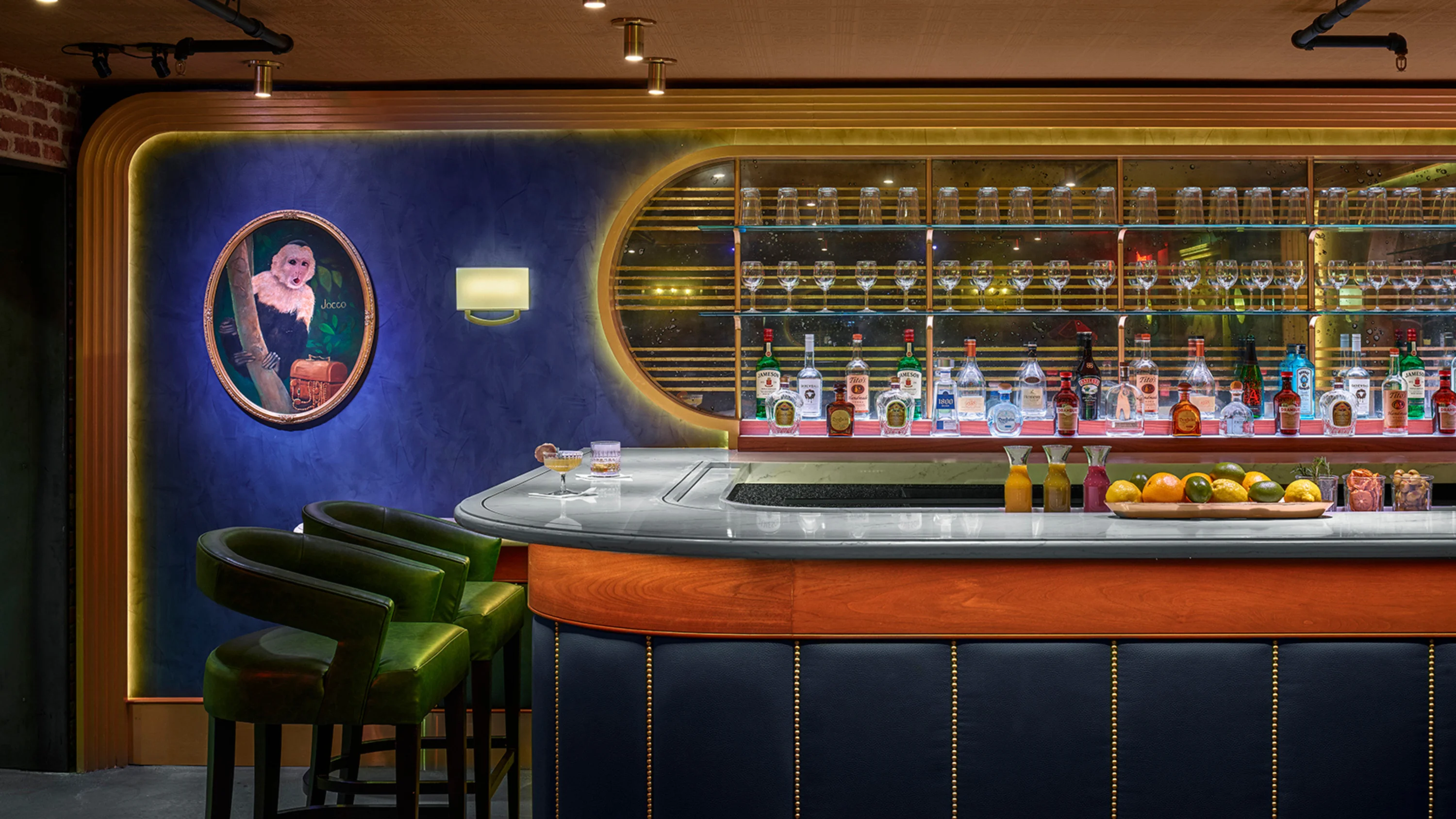
While staying at the Hotel America in New York in 1901, her favorite pet, a capuchin monkey named Jocco (think Spike from the film Ace Ventura: Pet Detective), was kidnapped. The kidnapper demanded $1,000 and one of Abreu’s diamond-and-emerald-studded bracelets, valued at more than $92,000 in today’s currency. Abreu refused to pay. Fortunately, police apprehended the kidnapper and returned Jocco safely to Abreu. Quirky stories like this are, in part, what inspired Irving Plaza’s interior design concept.
“Finding a clear narrative or story on which to base all of your design decisions is not just a trend in hospitality, but a driving force that is here to stay,” said Ryan Leichtweisz, RA. “The idea is that once you find the big design narrative, it guides your every design decision. And it really keeps the project focused and heading in one clear direction.”

Various newspaper clippings recount Jocco’s kidnapping and ransom, alongside a Spanish-language posthumous tribute to Rosalía Abreu that reflects on her deep affection for primates and notes that, after her death, she “left a fabulous sum dedicated to their care and maintenance.”
The building’s history led to a design concept that permeated the project. From a Gilded Age hotel to steampunk playground, 15 Irving Place provided a series of themes from which to draw inspiration. The story of the ransomed Jocco, for example, served as the focal point for one of the most elaborate new spaces in Irving Plaza.

Upscale Exclusivity
Abreu, a well-known socialite, hosted exclusive gatherings at her New York residence. The design team aimed to recreate a modernized version of an Abreu entertainment space for Irving Plaza’s VIP lounge.
The design intent was to create an upscale, turn-of-the-century entertainment space. From the new staircase down from the lobby bar, guests are greeted by a custom portrait of Jocco and the brand-new VIP cocktail bar. The threshold leading to the bar is clad in reclaimed NYC brick. Details like emeralite lamps and vintage footlights, borrowed from the theater above, boldly punctuate the lounge seating. Guests can sit and imbibe around new built-in walnut bookcases, with upholstered banquettes beneath a new embossed ceiling.


Antiqued mirrors and vintage candelabra wall sconces add reflection and warmth to the room’s far end. A repurposed phonograph now serves as a tabletop lamp. Introducing traditional classical moldings, salvaged brick, brass inlays, antique seating, rich textures, and saturated colors brings warmth to this cozy lounge, creating the perfect spot to enjoy a cocktail before or after the show.
“Our intent for the VIP lounge was to make it feel exclusive and upscale,” said Noon. “We envisioned Abreu entertaining down there. But the upstairs is where the old merges with the new.”

First Impressions
As guests pass under the refurbished marquee outside, they cross the lobby floor, marked with a new custom hexagonal mosaic piece bearing the Irving Plaza name. A turn-of-the-century aesthetic brings energy and personality to the space, something the building lacked before the renovation.
“It wasn’t really a great first impression from a hospitality aesthetics standpoint,” said Noon.

The team wanted to retain some elements of the original building, but to enhance the concertgoer experience, others needed to be replaced or refurbished. Exposed pipework was relocated; the original chandeliers required cleaning, rewiring, and refurbishment; and the ornamental tin ceiling was replaced in kind after the ceiling was removed to install acoustic upgrades. Structurally and acoustically, the building required reinforcement to withstand an enhanced sound system and lively crowds.
“Irving Plaza was originally built as a rowhome made with stacked stone rubble walls down in the basement and designed to accommodate a modest number of people,” Leichtweisz added. “Now 900 concertgoers are jumping up and down on a dance floor. The structure needed to be upgraded to reinforce it for today’s use.”

Leather and Lace
The first floor had multiple terraced levels, and the bar was a step up from the main entrance floor. The renovation levels out the entire first floor, streamlining accessibility and functionality.
“Our design restructured the floor to level the whole thing out, making it more accessible, inviting, and flexible for guests and venue operations,” said Leichtweisz.
The new lobby bar was designed with classic wood details and elements inspired by NYC bars and early-1900s café counters. Here, the design team combines classical finishes with urban steampunk detailing – “where leather meets lace.”

The patterned wallcovering draws on Victorian influences but adds a twist to those classic styles. Subtle design moments blend an upscale look with a rock-and-roll attitude, honoring the rock artists who have played Irving Plaza. For example, the wallcovering in the new lobby bar is a classic flocked damask pattern, but when viewed from afar, it has a hidden twist (see if you can spot the Devil in the details on the wall during your first visit).
“Some of that space is meant to be irreverent,” said Leichtweisz. “It’s meant to be playful. While we’re being inspired by the more buttoned-up history of the place, we have to remember that these people are here to have a good time.”

Reinventing Tradition & Maintaining Continuity
The Music Hall remains a double-story ballroom, preserving key elements that Irving Plaza is known for: embossed tin ceilings, crystal chandeliers, and a polished wood dance floor. The main hall presented a small challenge for the design team tasked with updating the space while maintaining its well-known characteristics.
The solution was to draw the audience’s eyes upward. The renovation adds a row of balcony boxes and standing platforms, offering guests an unparalleled view of the stage along the mezzanine. The balcony is wrapped with custom railings, fascia trim, and light fixtures that elevate the classic room.

“When the room is packed with people, all you have to work with from a design perspective is the ceiling,” said Noon. “We wanted to keep what was there and add visual interest to the edge of balconies.”
The new bars at the back of the room on the main floor and up on the mezzanine are also designed to attract attention. They are more contemporary in style, and their materials remain consistent across all new bars in the project. They consist of reclaimed NYC brick, woven-metal-mesh doors over liquor storage, and metal-clad pilasters on the bar front. The backlit amber inset panels on the bar tops are a contemporary feature that draws guests toward the glow at the back of the room.

A Personal Touch
Throughout the experience, the design team found small ways to incorporate their personal life experiences and parts of themselves into the design. They could imagine themselves in the shoes of those who have walked 15 Irving Place’s halls, like Mrs. Abreu and previous throngs of screaming music lovers.
“In one hall, we added a portrait of a walrus dressed in a European-style, 19th-century military uniform and bathroom wallpaper marked with small lightning bolts,” said Noon, a nod to her own music favorites, like The Beatles and David Bowie. “Some of the new light fixtures are identical to what my grandmother had in her house. They were perfect for this project.”
Drawing inspiration for a new design concept often originates with the building and the client, but adding a personal touch here and there is almost unavoidable.
“I think every designer puts a little bit of themselves in every project,” said Leichtweisz.
History has a way of leaving its indelible mark on the future. Great leaders, artists, and global events, both natural and man-made, live on in infamy, molding their present and ultimately making an impact on the future. But as the design concept for Irving Plaza has shown, you don’t have to be famous or powerful to shape the the spaces we inhabit today. Sometimes, you can be as small and little known as capuchin monkey.