
From swamp to Super Bowls, Springsteen and Swift: the Meadowlands turns 50
Press
This article was originally published by NJ.com on September 1, 2026, and written by Phil Cornell.
Half a century ago, New Jersey’s big bet that an expanse of swampland could be used for more than a dumping ground, that it could be a major source of revenue and pride instead of embarrassment, started to pay off.
The Meadowlands Sports Complex was an immediate hit when it opened Sept. 1, 1976, with a racetrack, the initial component of the $342 million facility. A crowd of 42,133 turned out that late summer night, producing the first of countless traffic jams leading to the site.
“By 7:30, roadways surrounding the East Rutherford track became a wall-to-wall’ parking lot, and some motorists abandoned their cars to run to the complex, which began turning away the overflow crowd,” The Star-Ledger reported, citing police.
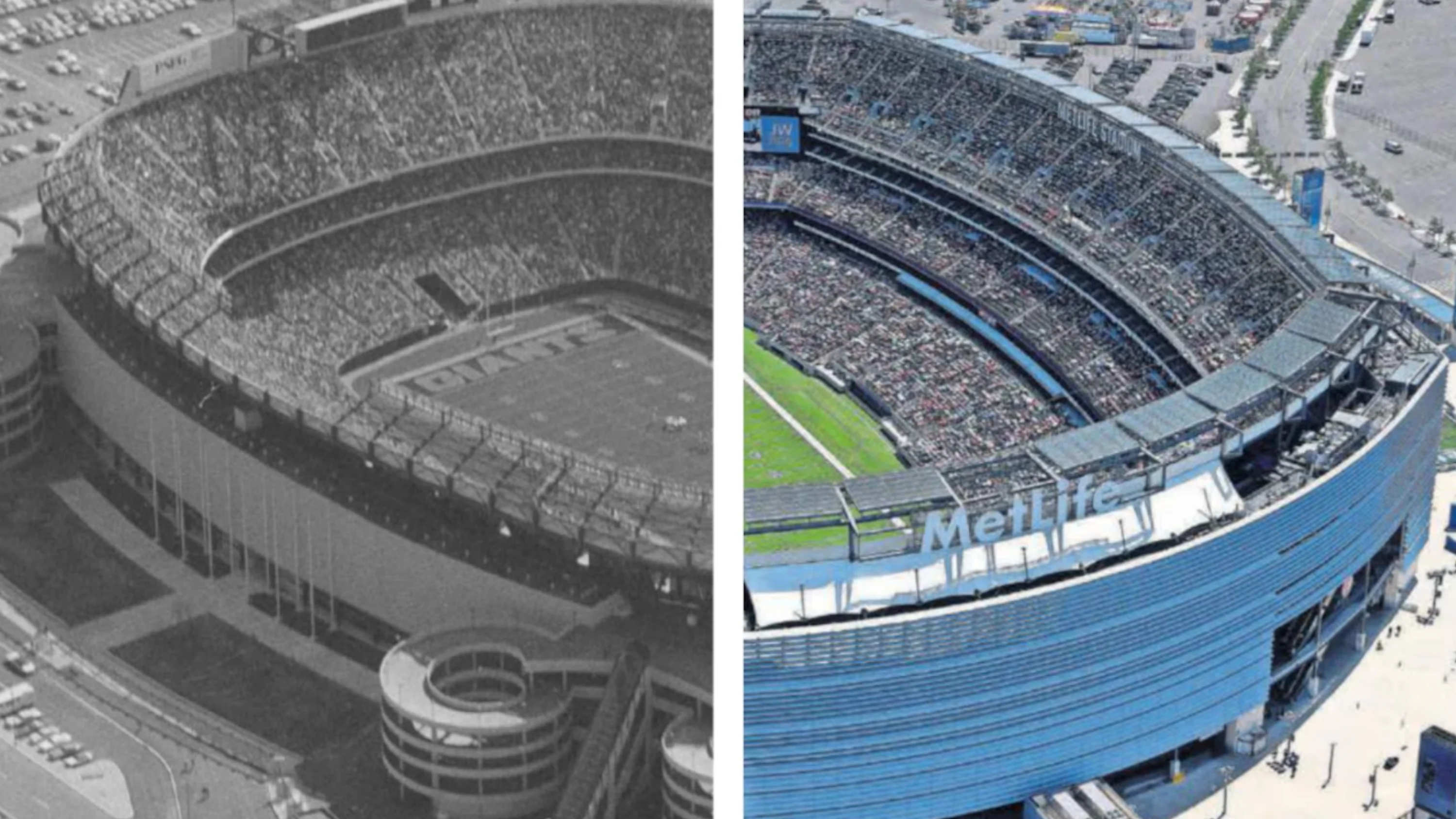
Giants Stadium debuted the following month as the home team hosted the Dallas Cowboys in front of 76,042 spectators, “the largest crowd ever to gather for a sports event in New Jersey,” this time without automobile gridlock, according to The Star-Ledger.
Giants President Wellington Mara, whose team had played in Yankee and Shea stadiums and the Yale Bowl over the prior three seasons, hailed their new home as “the miracle in the Meadowlands.” A Star-Ledger reporter dubbed it “the house that Sonny Werblin built,” a reference to the powerhouse chairman of the New Jersey Sports and Exposition Authority in charge of the complex.
“It’s a day that gives New Jersey a new identity as a big-league state,” proclaimed then-Gov. Brendan Byrne.
Byrne was booed at the track’s opening, no surprise given the start of the state income tax at the time, but his name would adorn the arena that arrived at the complex five years later at least, that is, until it was corporate-branded for Continental Airlines and then Izod apparel.
In the ensuing decades, Byrne’s “big-league” designation was repeatedly borne out.
On the gridirons of Giants Stadium and its successor, MetLife Stadium, Big Blue marched to four Super Bowl titles. The Super Bowl itself was played there in 2014, a rare appearance in a cold-weather setting.
Two of the three Stanley Cups won by hockey’s New Jersey Devils were hoisted at the arena. Basketball’s nomadic Nets spent nearly three decades playing in the building, bringing the NBA Finals there twice, while the Final Four of the men’s college hoops returned to the New York area in 1996 after decades away.
Mega recording stars from Sinatra to Springsteen to Swift have thrilled fans at the venues, with Bruno Mars recently completing a four-night run at MetLife. Mass celebrated by Pope John Paul II at Giants Stadium in 1995 drew 83,000 of the faithful.
Even as cheers filled the air attions of national and even global significance, the economic impact resonated locally.
“It was an incredibly vibrant place,” said Carlstadt administrator Robert Ceberio, who recalled moonlighting at the “Big M” for the track’s debut and beyond. “It created a significant amount of jobs, whether it be part-time or moonlighting or even full-time jobs. … It was a great moneymaker for the state and, more importantly, it did provide money for the (employees’) families.”
Jim Kirkos, president and CEO of the Meadowlands Chamber of Commerce, sees it similarly.
“The popularity and the importance of the complex cannot be overstated,” Kirkos said recently. “It’s been the economic driver of the growth over the last 50 years.”