

Richard A. Balderston OPC’69 Lower School
Philadelphia, PA
William Penn Charter School, the nation’s oldest Quaker school, envisioned a transformative campus plan to unite its youngest learners under one roof. As the capstone project of a multi-phase campus transformation, The Richard A. Balderston OPC ’69 Lower School completes the vision of an academic village by integrating Pre-K through Grade 5 within a shared home that embodies the school’s values of community, stewardship, equality, and simplicity.
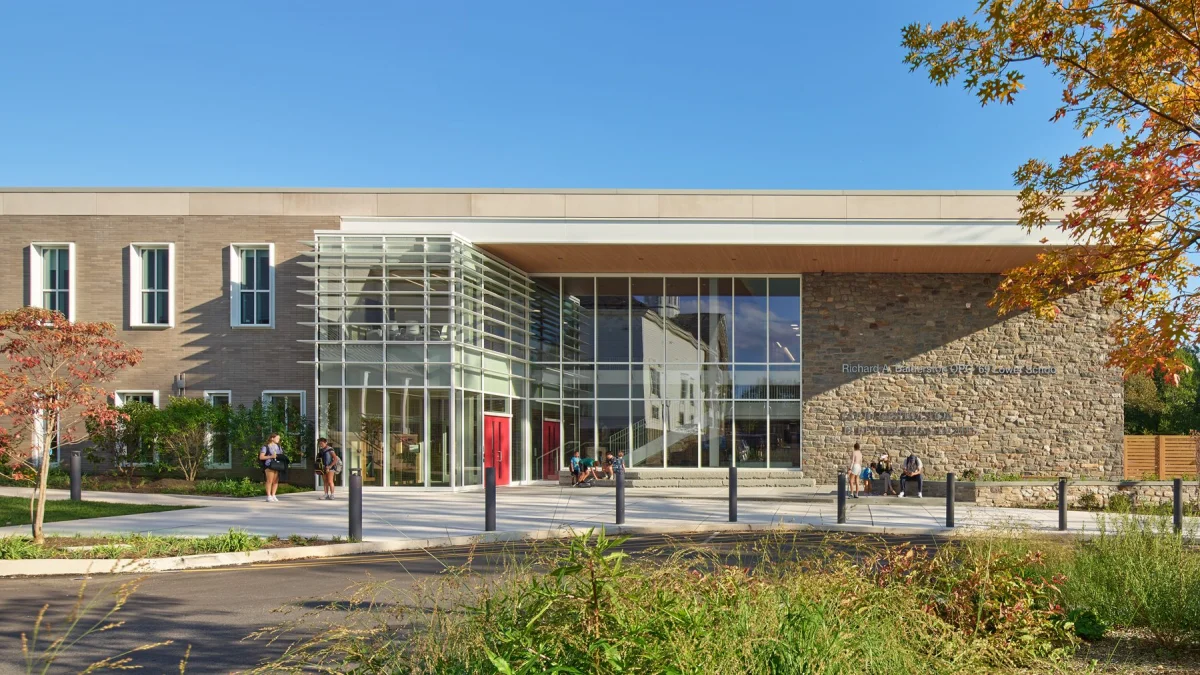
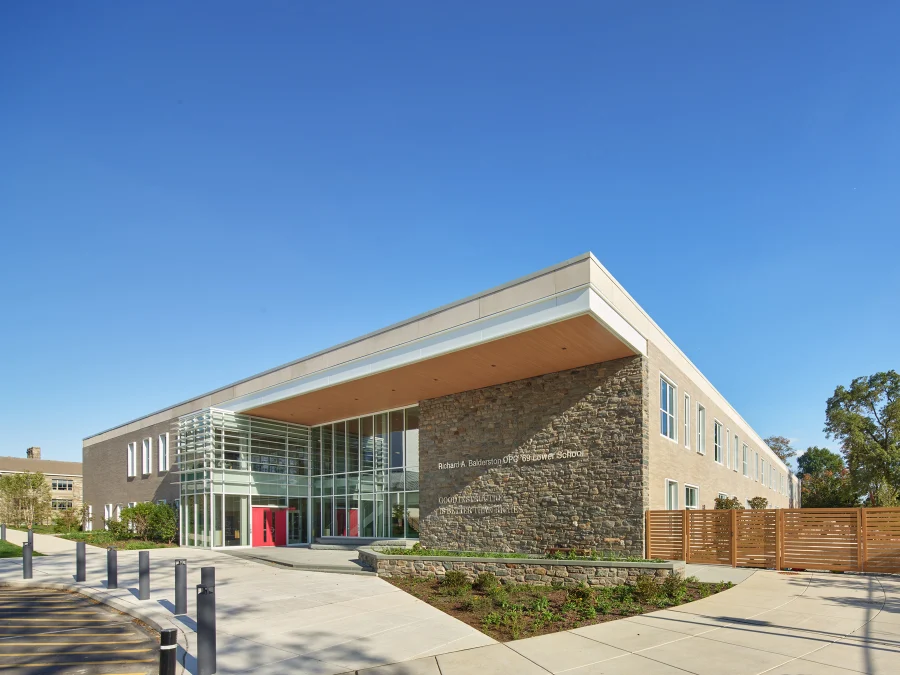
The two-story, 78,000-square-foot facility now anchors the southwest corner of the campus, a site that previously held parking, an aging field house, yard storage, and mechanical equipment. The project itself is the result of years of collaboration between EwingCole’s design team and administrators, educators, families, alumni, and community members. The design concept creates a protected enclave for the school’s youngest learners, inspired by nature while employing a contextual yet playful and modern architecture and interior design. The landscape and play areas are conceived as a place of exploration, intended to mature to a “learning forest” in the years to come.
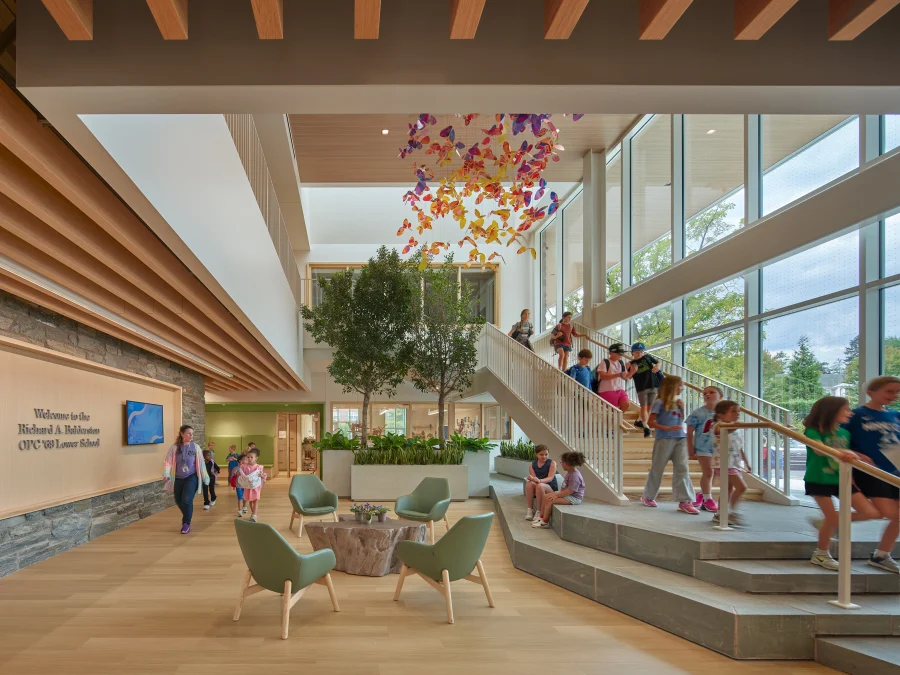
.
Rooted in Quaker Values and Reggio Emilia Philosophy
Quaker principles guided every aspect of the design, from site placement and building height to materials and light. Keeping the building within two stories fosters connection between age groups and preserves the school’s sense of community. A linear, 250′ skylight, stretching nearly the entire length of the building, symbolizes the Quaker belief in inner light while infusing the interior with daylight that changes throughout the day.
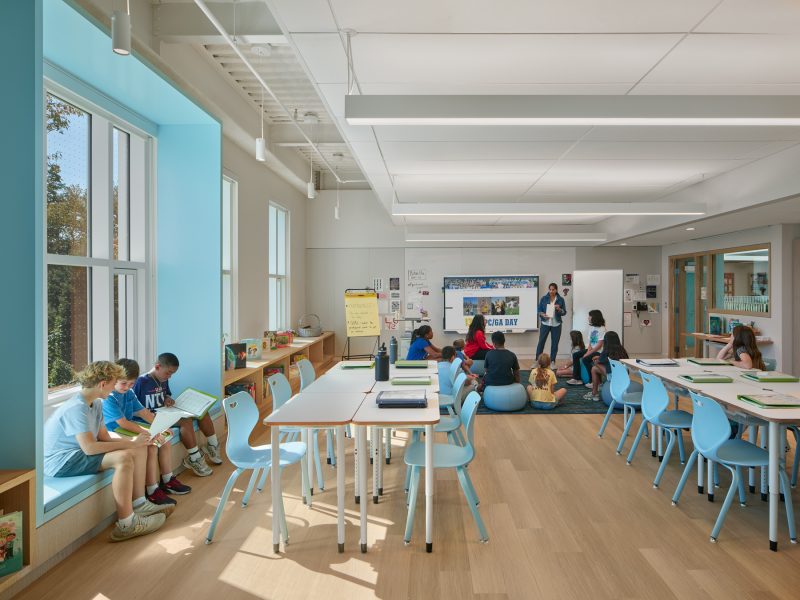
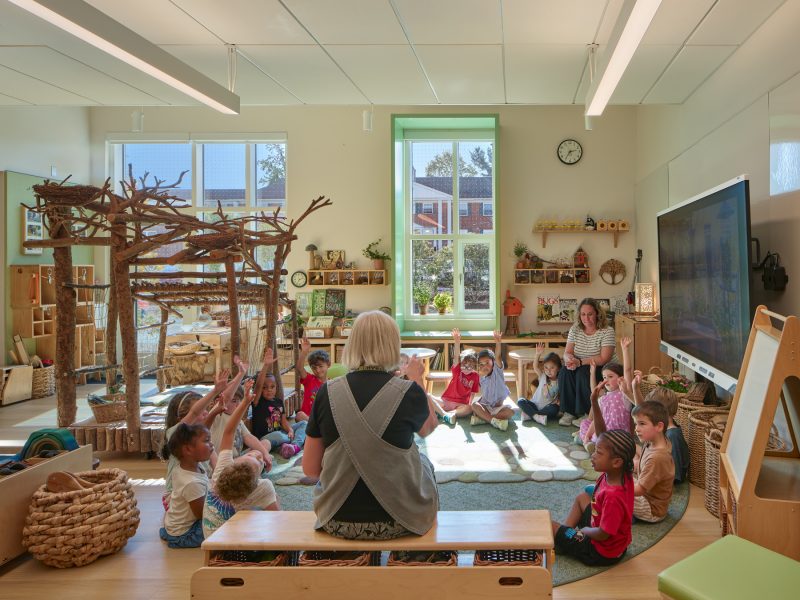
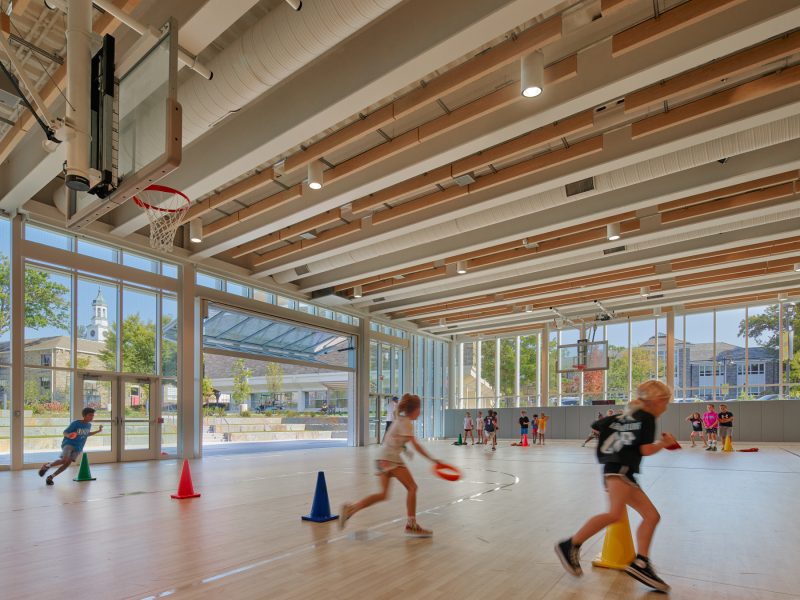
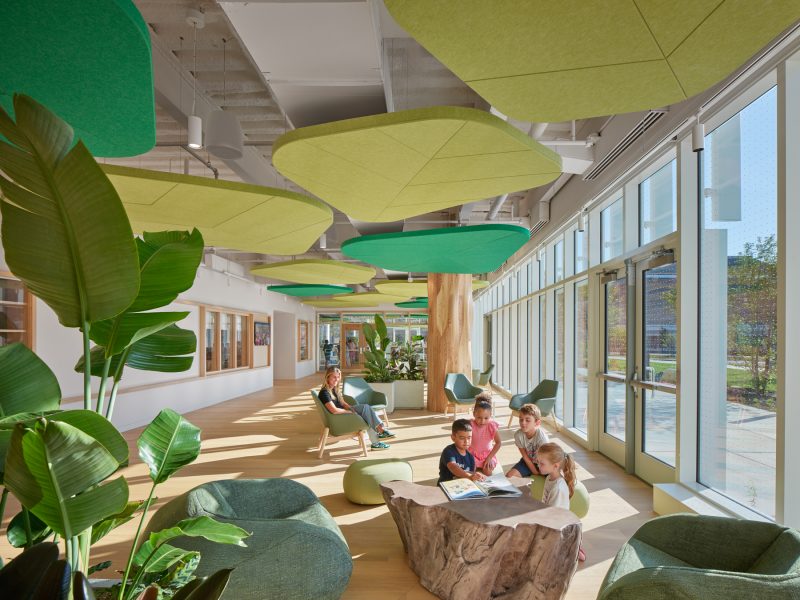
The Reggio Emilia pedagogy further shaped the design of learning environments, emphasizing flexibility, exploration, and engagement.
The Reggio Emilia approach is an educational philosophy that emphasizes self-directed learning through exploration, collaboration, and projects. Key to this approach is an emergent curriculum based on children’s interests and their environment as a “third teacher.”
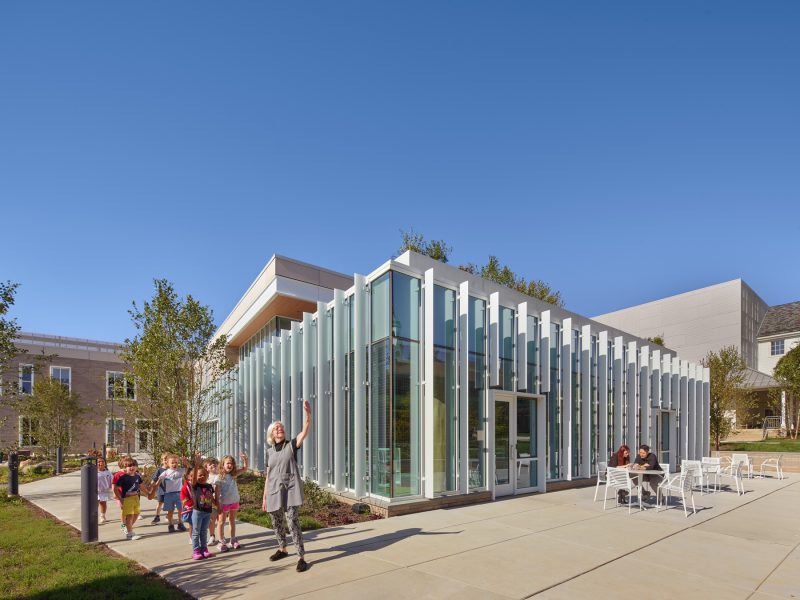
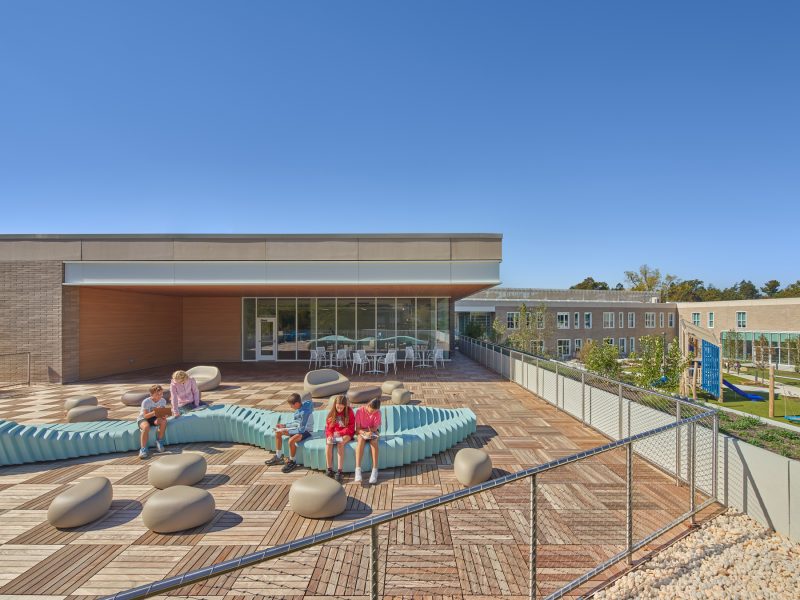
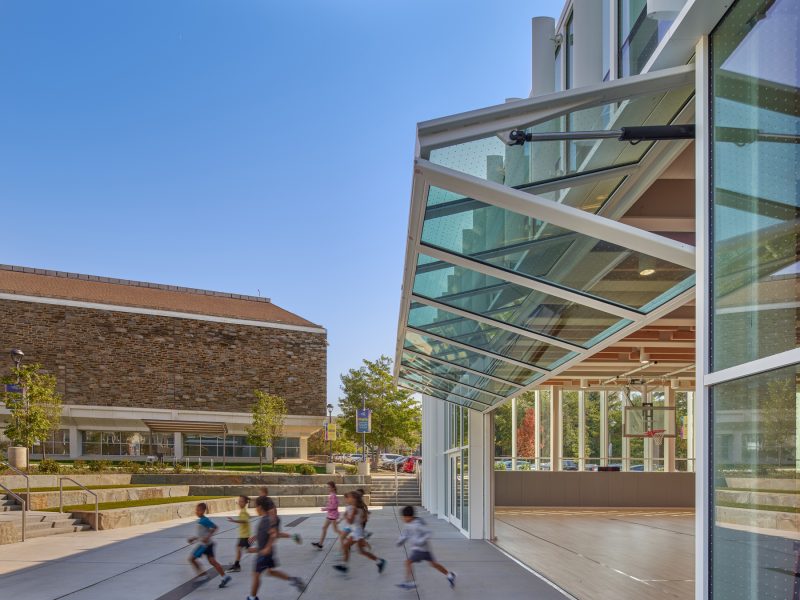
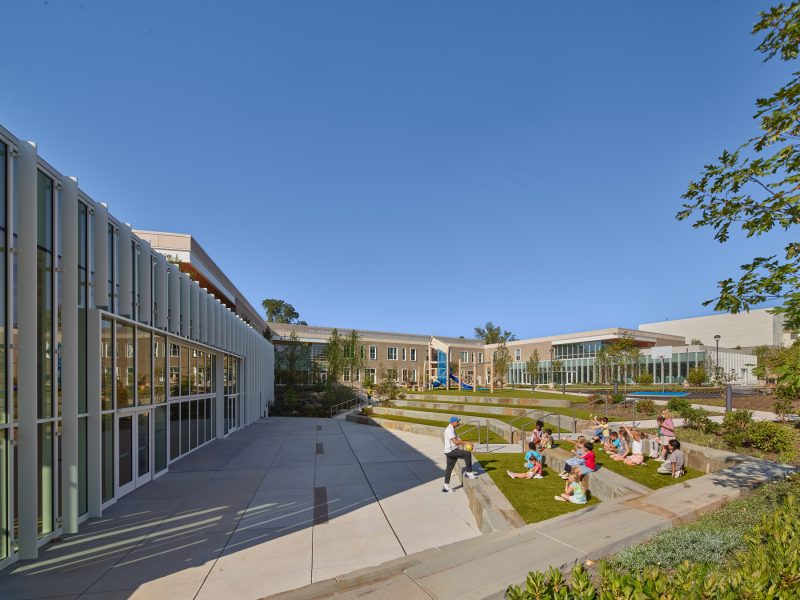
Classrooms open directly to outdoor learning terraces and play areas, supporting a seamless relationship between indoor and outdoor environments. The flexible layouts empower teachers to adapt spaces for project-based learning, creativity, and discovery, while maintaining a consistent material and color palette that promotes calm and focus.
Architecture Inspired by Nature and Place
The building’s exterior is rooted in place. The simple massing employs a palette of brick to match the Graham Athletic & Wellness Center and Wissahickon Schist at the entry, tying the new building to its historic campus and natural context. White trim at punched windows is a contemporary interpretation of the colonial revival windows of the original campus buildings, while modern glass volumes are adorned in vertical sunshades, providing an enigmatic play of mass and transparency from different angles. At building entrances and roof terraces, the facades are carved back, revealing surfaces of wood and expanses of glazing beneath cantilevered roofs.
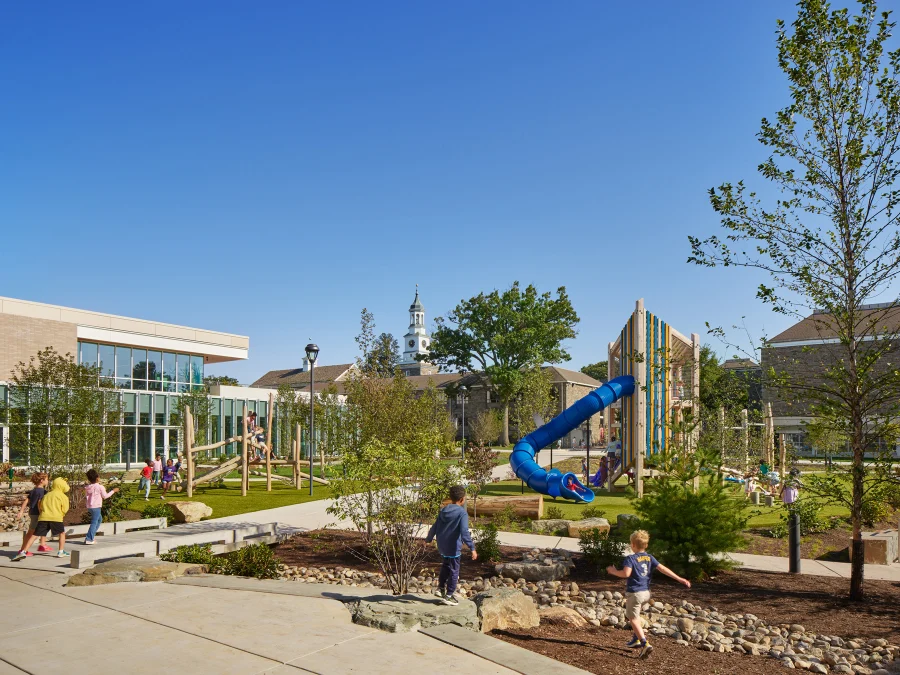
The building’s layout draws inspiration from the nearby Wissahickon Valley Park. Its meandering configuration evokes the flow of the river, while the layered materials and offset corridors mirror the valley’s stratified landscape. The central spine of the school acts as both circulation and gathering space, with bridges and openings connecting younger and older students. Along the way communal nodes such as Friendship Hall and the Founders’ Entry encourage interaction and reflection.
At key points of entry and interaction, the school’s community focus and Quaker values are articulated through student-derived artwork and environmental graphics. Two dynamic, hanging sculptural installations were adapted from an all-school mural in the old lower school building that embodied the diversity and sense of community among friends, as Quakers refer to one another. The old mural’s colors and graphics are reconstituted as a group of butterflies taking form and taking flight, an analogy for the transformation of students during their time at Penn Charter. At several prominent interior vistas, student-generated word clouds energetically speak to key quaker values.
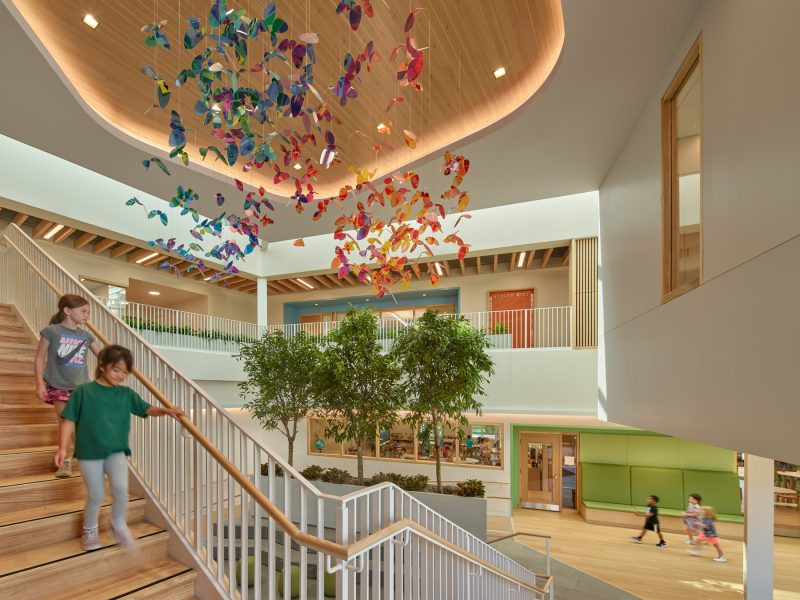
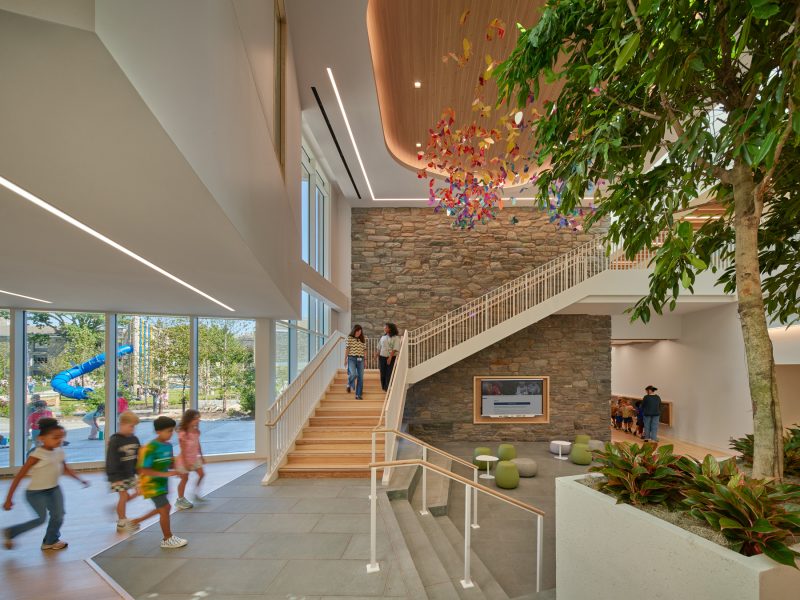
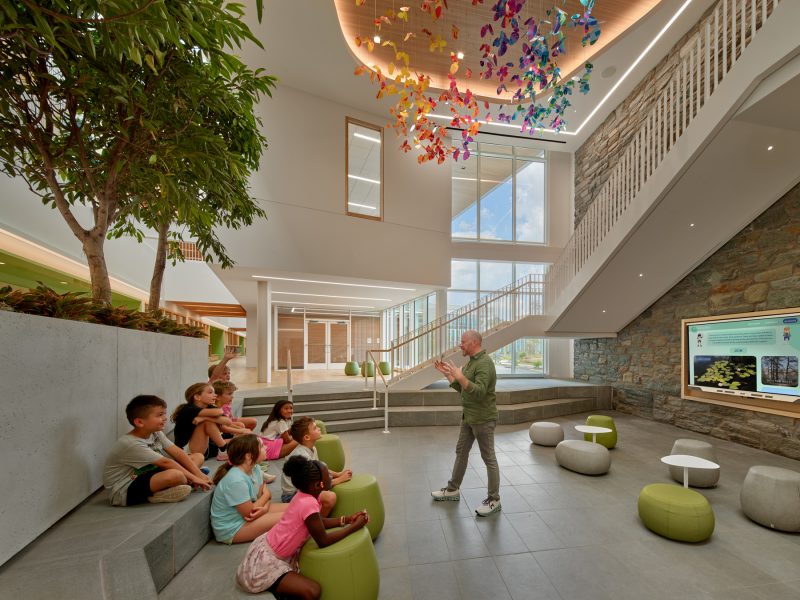
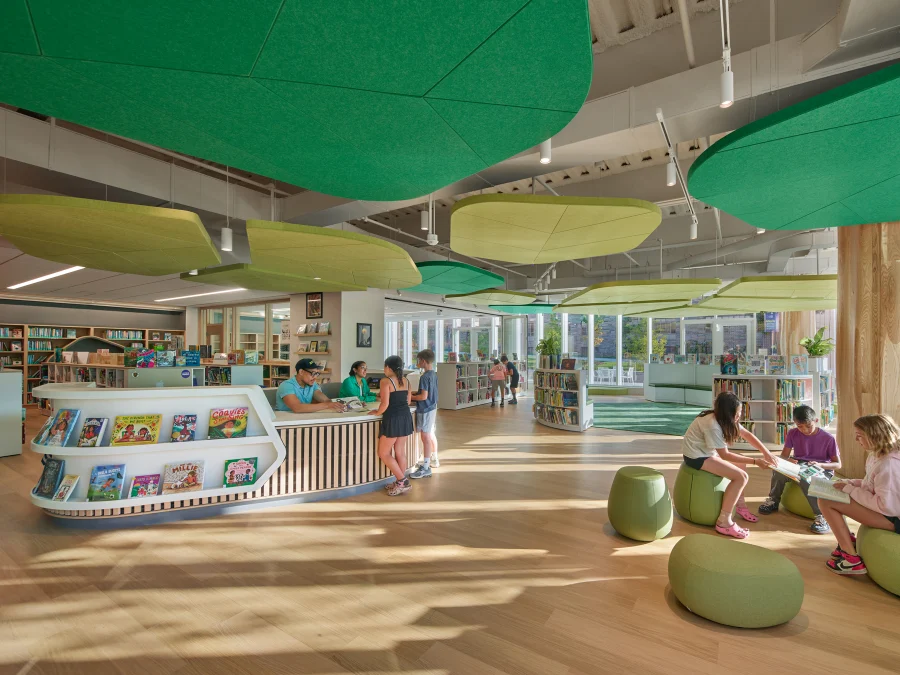
Biophilic design elements include a combination of actual living elements – like the trees and plants occupying key interior spaces and corridors – as well as nature-inspired design elements and materials, such as the tree trunk columns, leaf-patterned ceilings, and wood floors and millwork. Expansive glazing frames views of the natural landscape, while the library and activity room act as beacons at either end of the building, symbolizing a balance between reflection and community. Both spaces open to exterior spaces that extend learning into the open air.
Designing for Play, Exploration, and Inclusivity
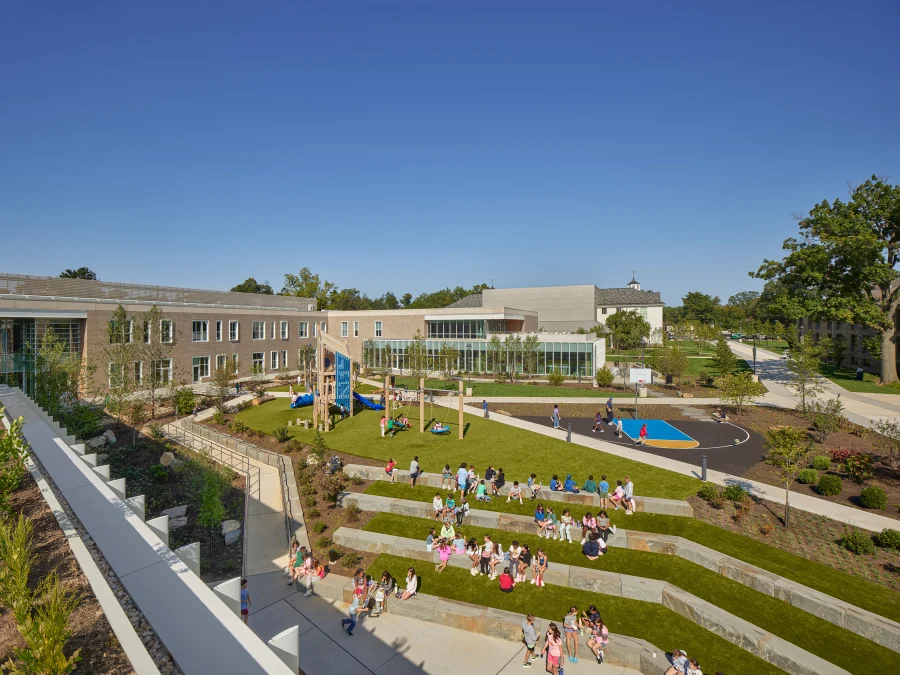
The U-shaped form features a courtyard filled with naturalistic play equipment, a student-controlled busy river and an amphitheater built into the landscape that is large enough to accommodate the entire Lower School community. The design prioritizes accessibility and inclusivity, ensuring that every indoor and outdoor space is accessible to students and visitors regardless of physical mobility or limitation.
Sustainability and Stewardship in Design
The Lower School is designed to meet LEED Silver Certification for Schools, reflecting Penn Charter’s commitment to sustainability and stewardship as core Quaker values. The design integrates environmental responsibility across all scales, from building envelope and materials to landscapes and energy systems, creating a holistic model of sustainable learning.
- Building Envelope and Materials
Vertical and horizontal shading fins reduce solar heat gain while maintaining daylight and preserving exterior views. The glass façade incorporates a ceramic frit pattern designed in accordance with the Audubon Society’s bird-safety guidelines to minimize bird collisions. The high-performance masonry rainscreen improves thermal efficiency and long-term durability. The roof is designed to carry a future photovoltaic installation to offset electrical usage. - Landscape and Site Systems
Outdoor spaces are conceived as a learning forest, featuring 246 new trees, preserved mature specimens, and diverse play and learning environments. Hidden subsurface stormwater basins manage runoff and protect nearby Schuylkill and Wissahickon waterways. Students interact directly with these systems through a hands-on busy river feature, which channels water from an on-site cistern into a rain garden near the amphitheater. - Healthy Indoor Environments
A continuous skylight and high-performance windows deliver natural daylight to classrooms and corridors, supporting cognitive performance and wellbeing. Interior finishes use low-VOC, recycled, or responsibly sourced materials such as FSC-certified wood and upcycled PET felt ceilings. The Wissahickon Watershed Map, printed as an acoustic wall treatment, combines environmental education with sound control. Continuous air-quality monitoring and occupancy sensors enhance efficiency and improve comfort and environmental conditions by optimizing light and air for young learners.
Through this integrated approach, the Lower School serves as both a high-performing building and a teaching tool, demonstrating environmental responsibility and inspiring students to care for the world around them.
A Space Where Learning Comes Alive
The Richard A. Balderston OPC ’69 Lower School stands as a living expression of William Penn Charter’s mission to “educate students to live lives that make a difference.” Thoughtfully crafted to embody Quaker simplicity, an appreciation for natural beauty, and educational innovation, it provides an environment where children learn not only about the world but also about their place in it.
Meet the Design Team







Design the Future
Explore career opportunities at EwingCole.